


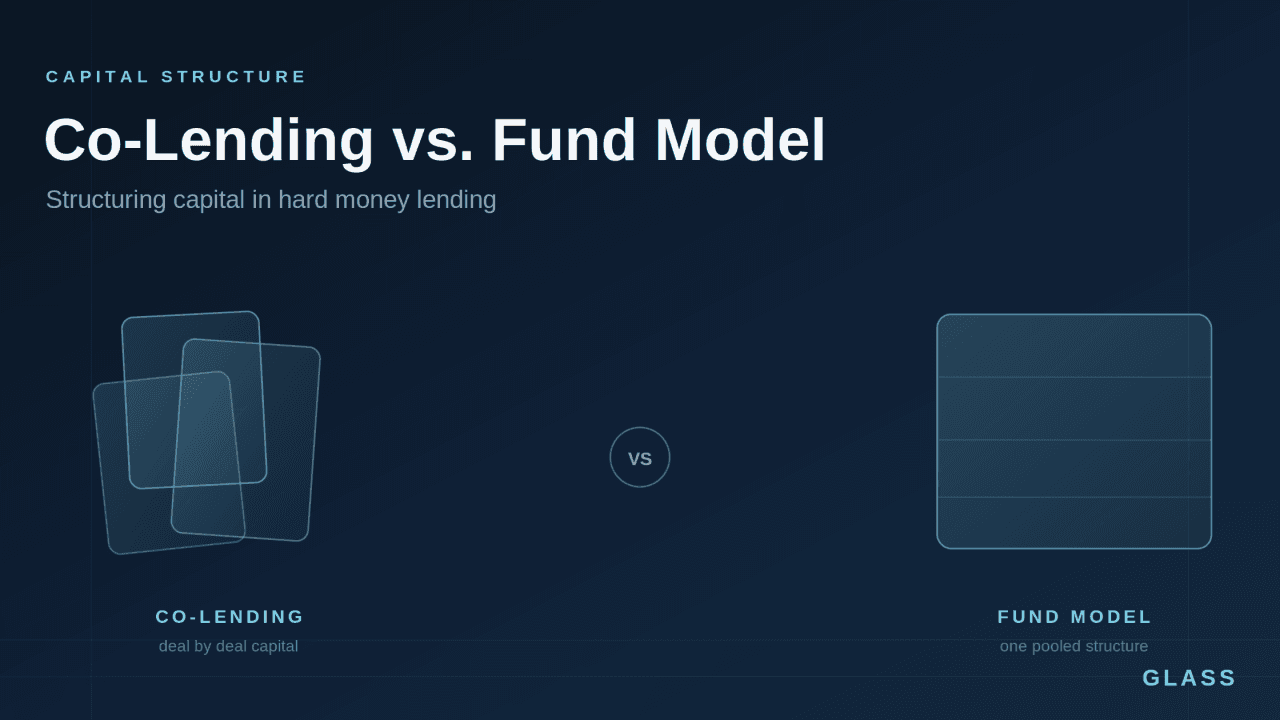
I get asked this constantly. Co lending or a fund model, which one should you use to raise capital for hard money lending?
There's no universal right answer. Both structures work. Both have real tradeoffs that show up differently depending on how fast you want to grow and how much operational work you're willing to take on.
Co lending means raising capital from individual investors on a deal by deal basis. You only pay yield once that investor's capital is deployed into a specific loan. When the loan pays off, you send the funds back or hold them in escrow and tell the investor plainly that they're not earning full yield while their money sits idle.
I think this is the healthier structure long term. It removes a specific kind of pressure that quietly distorts underwriting decisions. When you don't owe yield on unused capital, you're not tempted to lend on a mediocre deal just to keep an investor's money working. The deal has to earn its place on its own merits.
The tradeoff is operational. You're tracking every investor's funds on a per deal basis. You're communicating constantly, updating investors on deal status, payoff timing, and next placements. Your capital stack is also less predictable. An investor whose money sits too long without accruing return may ask for it back, and you need to plan around that possibility.
A fund model pools capital from multiple investors under one fixed return or waterfall structure. Investors commit capital to the fund itself, not to individual deals, and you deploy that capital as opportunities come up without checking in on every placement.
This scales faster and takes less day to day management. You're not coordinating individual investor updates for every loan. You're managing one pool against a portfolio of deals.
The tradeoff is cash drag. Depending on how the fund is structured, you can end up holding a meaningful amount of undeployed capital while still owing a return on it. That creates real pressure to place capital even when the deal flow isn't there to support it. It's one of the more underdiscussed risks in fund structures, and it's the main reason some operators avoid the model entirely.
Some lenders build hybrid structures to address this, like a floating rate inside a fund that adjusts based on capital utilization. Investors earn less when capital sits idle and more once it's deployed, which softens the cash drag problem without giving up the scalability of a fund.
We chose the fund model at UrbanGate Capital to prioritize scale. We still run co lending deals when the fund is fully deployed and a good opportunity needs capital fast. Neither model has to be exclusive.
Once you're past a handful of loans, the structure you choose becomes a tracking problem as much as a capital problem. Co lending requires tracking dozens of individual investor positions across active deals. A fund requires tracking utilization, waterfall calculations, and investor returns across the whole portfolio. Spreadsheets can handle this for a while. They stop working the moment your loan count and investor count both start climbing at the same time.
That's part of why we built Glass, to give lenders running either model, or both, a single system to track deployed capital, investor positions, and fund performance without rebuilding a spreadsheet every time the portfolio changes shape.
If you're still early and running a handful of loans off a spreadsheet, you'll feel the ceiling coming. It shows up faster than most people expect.
Discover how private lenders use Glass to manage loans and gain better visibility across their portfolio.
Book a personalized 30-minute demo to see how Glass would work for your business.
Book a Demo